CAGR and XIRR both express an investment’s return as a percentage per year. CAGR works when you invest once and withdraw once. XIRR is built for the reality of many investments made on different dates, like a Small Savings, SIP.
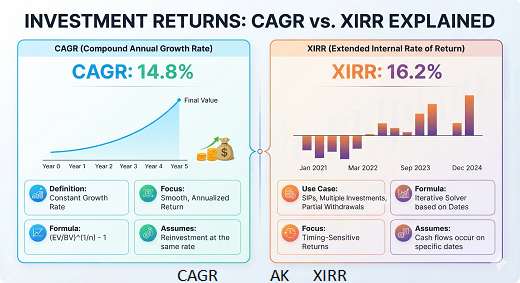
What is CAGR?
CAGR (Compound Annual Growth Rate) is the steady yearly rate at which a single investment grew from start to finish. Its formula is:
CAGR (%) = ((Ending Value ÷ Starting Value) ^ (1 ÷ number of years) − 1) × 100
Example: you invest ₹2,00,000 once, and after 10 years it is worth ₹6,21,169. CAGR = ((6,21,169 ÷ 2,00,000) ^ (1/10) − 1) × 100 ≈ 12% a year. CAGR assumes one inflow at the start and one value at the end, which is exactly why it fits lump-sum investments.
What is XIRR?
XIRR (Extended Internal Rate of Return) is the single annual rate that ties together many cash flows happening on different dates. It accounts for both the amount and the exact timing of every investment and withdrawal. There is no simple hand formula; it is calculated by a spreadsheet using the XIRR function, where you list every cash flow (money invested as negative, money received as positive) against its date.
Why in SIP
In a SIP, each monthly instalment is invested for a different length of time, the first for the full period, the last for barely a month. CAGR cannot handle that, because it assumes a single start date. XIRR can, because it weights each instalment by how long it actually stayed invested.
CAGR & XIRR Calculator
Calculate CAGR (Lump Sum)
Calculate XIRR (Cash Flows)
Enter investments as negative values and final values/returns as positive.
NSE (National Stock Exchange ) Website link for any stock and index . For any Mutual Fund SIP Investment and insurance Related Kindly Connect me on Either on My Contact Number whatsapp -7827119976/ 9555591187 or Email id- Capitalvaluator@gmail.com
Big Mistake : Don't Compare a Fund's CAGR to your XIRR
A fund may advertise a 12% CAGR while your statement shows a 10% XIRR on the same fund, and both can be correct. The CAGR describes a lump sum held for the whole period; your XIRR reflects your specific instalments.
- XIRR needs the exact amount and date of every transaction
- CAGR is only meaningful over a single, always note the years it covers.
Conclusion
CAGR and XIRR are both annual return figures, CAGR for a single lump sum and for comparing funds, XIRR for the real-world mix of SIPs and withdrawals that makes up most portfolios.